

Criminologist warns of rural domestic homicide risk in Longford conference
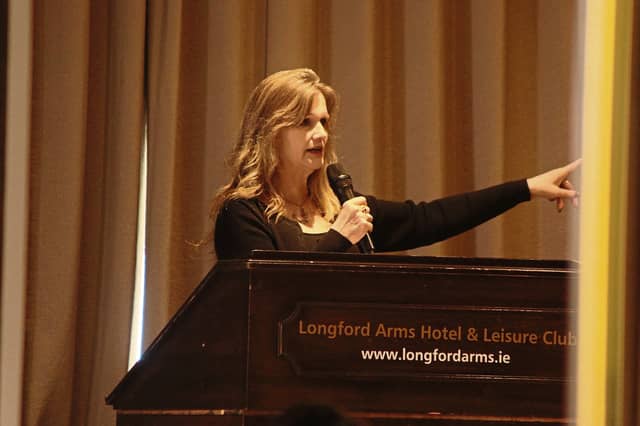

Professor Jane Monckton Smith OBE: ‘Domestic abuse isn't a row, it’s when one person becomes a threat to another’
In rural Ireland, there’s always a concern that cases of domestic abuse - be they physical and/or psychological - risk going undetected due to the isolated nature of life ‘in the sticks’. It’s a concern that carries merit.
All too often we see national headlines of a murder victim’s spouse being convicted of their killing, while on a more local level, the weekly sitting of Longford District Court is rarely without domestic violence cases making an appearance on the list for a private hearing.
In an effort to strengthen frontline responses to domestic abuse, as well as sharpen professionals’ understanding of the mindsets of abuse victims, and the behaviours and tactics of their abusers, Longford Women’s Link (LWL) invited internationally renowned criminologist, Professor Jane Monckton Smith OBE, to deliver a two-day training seminar, titled, “Responding to the Risk of Domestic Homicide in Rural Ireland.”
Professor Monckton Smith, who specialises in homicide, coercive control, and stalking, spoke to a packed room of industry professionals in the Longford Arms Hotel last Tuesday and Wednesday, holding the attention of every attendee as she walked through multiple case studies in addition to unpacking in-depth topics such as the ‘8 stages to domestic homicide’,
‘suicide/violent resistence timeline’, and, ‘honour based abuse’.
Also addressing the crowd at the seminar were Tara Farrell, CEO of LWL, Raymond McMahon, Chief Superintendent, and Natalie O’Reilly, Manager of the Domestic Abuse Response Team.
Information packs handed out on the day contained reams of helpful data and insights, however probably the most impactful of all were the two pages that both contained a map of Ireland; one filled with images of murdered women, the other, images of murdered children.
Even more hard hitting is the small note at the bottom of the both maps where it explains that the image “shows just some” of those murdered and you realise the number of victims is perhaps such that there’s not enough space to include them all in the one page.
A man whose sister was sadly one of the women featured in the image was also in attendance for the seminar. Activist and teacher, Jason Poole, lost his sister Jennifer in 2021 when she was murdered by her ex-partner, Gavin Murphy, whom she was unaware had a history of domestic violence and convictions.
Jason is now campaigning for legislation and a domestic violence register called ‘Jennies Law’ so women can find out if their new partner has previous convictions or a record of abusive episodes.
The seminar drew attendees from all over Ireland and from a variety of fields, such as policing, law, HSE, Tusla, social work, and activism, all of whom, like Jason, want to prevent as many families as possible from suffering the needless loss of a loved one.
Professor Monckton Smith’s compelling insights, can be found in her book, ‘In Control: Dangerous Relationships and How They End in Murder.'