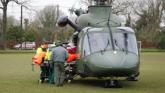
'We have a rule of law in this country' - Army deployed across Ireland amid fuel protests
Search


09 Apr 2026

Please allow ads as they help fund our trusted local news content.
Kindly add us to your ad blocker whitelist.
If you want further access to Ireland's best local journalism, consider contributing and/or subscribing to our free daily Newsletter .
Support our mission and join our community now.
To continue reading this article, you can subscribe for as little as €0.50 per week which will also give you access to all of our premium content and archived articles!
Alternatively, you can pay €0.50 per article, capped at €1 per day.
Thank you for supporting Ireland's best local journalism!

Former State Pathologist, Dr Marie Cassidy, will be interviewed by bestselling author Paul Williams

Former state pathologist-turned-crime-novelist Marie Cassidy said many Irish writers had contacted her over the years asking her 'the best ways to kill people' and she never expected she would be the one creating the stories and violent acts.
The respected academic will be one of the headline guests when she is in conversation with well-known journalist Paul Williams at the upcoming Granard Booktown Festival on April 19 and attendees can gain unique insights into her fascinating career.
Dr Cassidy moved to Ireland from Glasgow to become the deputy state pathologist in 1998 and she dealt with hundreds of murders and she performed thousands of postmortems up until her retirement in 2018.
She said she is looking forward to attending the event in Granard and she praised the line-up of guests and authors.
"Yes, they seem to have done very well and attracted people there so yes it should be good."
Read: Granard Booktown Festival to bring renowned authors to Longford
She published her best-selling memoir 'Beyond the Tape: The Life and Many Deaths of a State Pathologist' in 2020 with Hachette Books Ireland, which offered fascinating insights into forensic science.
The publishing company then surprised her by asking her if she would consider writing her first fiction book and she subsequently penned 'Body of Truth', a crime thriller which follows Dr Terry O'Brien, a Scottish pathologist working in Ireland.
Dr Cassidy said she considered it and she decided to give it a go.
"It's something completely different for me, that I've now gone into writing, which I never thought I would ever do, not in a million years.
“It's just something that, like most things in my life, it just kind of happened."
Dr Cassidy said the opportunity came along and her background and experience following a career of more than 30 years dealing with murders and carrying out postmortems was the catalyst for it.
"I think that's why they suggested I do it because I had that.
"It wasn't something I thought about doing until I was asked if I would like to have a go.
"But I had spent a lot of time with a lot of the Irish writers because whenever they were wanting to know the best ways to kill people they would come to me and just check that they'd got it right, making sure they were accurate.
"So, I had been on the fringes of that world but I never thought I would be part of it.
"It came as a big shock to me when I was offered a deal to have a go at writing myself and I realised these people are very clever.
"They make it look easy and it's not."
Read: Man accused of having knife charged in connection with South Longford aggravated burglary
Dr Cassidy said Paul Williams was one of the writers who contacted her when he was working on one of his books and she believes their conversation will be enjoyable.
"For his first book it was Jack Harbison he spoke to and then he came to me when he was writing one of his other ones."
"I've known Paul for a long time and we got on well together so we're just hoping it'll be a lot of fun."
Dr Cassidy believes she was very fortunate to break into writing novels.
"I know a lot of people want to write and they can't get their foot in the door and I was just very fortunate that after I had done my memoir they said, 'Well, why don't you try that'.
"I said I'd try it but I can't guarantee it will be any good."
Dr Cassidy said she did not have a structured or disciplined daily or weekly routine for writing her novels and her writing process and her approach was more 'haphazard'.
"I've spoken to so many writers about how they go about it and to be fair most are very different.
"I'm not that way inclined, I must say.
"And I never was, even when I was in my normal job and I had to write reports.
"There's some days you'll sit down with that paper and you'll go, 'Ah Jesus this is a waste of time, I can't think of anything'.
"And I had always learned that you put it aside and then you come back to it.
"So, that's the way I've been doing it with this writing."
Read: A lotto luck in Longford: Paddy strikes it lucky by winning Cashel GAA lotto jackpot
Dr Cassidy described her writing process style as being a bit of a trial and error process.
"I have spurts where I do things and then I might go, 'Na I'm not happy with that' and I go away and talk to myself for a few days or a couple of weeks and then think, 'That's where I need to go, that's what I should have said', and then I go off again.
"So, it's very haphazard, but don't tell the editor that," she laughed.
Dr Cassidy said she is amazed to have three books written and she suggested she was trying to find a formula that was not there for a crime thriller when she embarked on her first fiction.
"The memoir was fine. But the first fiction was painful because I really was a novice and I had no idea and because I'm a scientist I kept thinking when it comes to things like thrillers and crime there's a formula in there, there must be...It can't just be that there are these magnificent writers who are word crafters [can do this] and I've got to find this formula.
"So, I spent my first one trying to get my head around how you do that because there is a way of writing these types of books that keeps people interested and keeps bringing them back.
"And I thought it's there somewhere, I've just got to find it," she laughs.
Read: Plans lodged to turn a Longford village post office into apartment unit
Dr Cassidy said she had the stories but when she submitted her first draft of her first crime novel to her author the feedback she received was that it needed some changes and more graphic detail.
"They just looked at it and said 'That's a bit too cosy crime, that's not what people expect from you'.
"I was going, 'Ah God, but I like cosy crime. I said I know I've spent my life dealing with mass murderers and all the rest of it but I'm not really into violence at all.
"I thought 'Okay I'll give it another go so I went away and I rewrote a few bits and pieces and brought it back and they went, 'Ah hold on, that's a wee bit too much now'."
Dr Cassidy said they eventually compromised on a 'happy medium' for the description of the violence and details.
She said her second novel 'Deadly Evidence' was so much easier because she had an idea what the formula was.
"All through my life all I've been doing is learning and sort of researching so doing the writing is no different.
"I'd be doing my research and I'd be talking to people and when they would say things I'd go, 'Gosh that would be a great idea to do it that way or end it like that and I'll keep all of this so I've just been sucking everybody dry.
"The second one was so much easier and I enjoyed it much more."
Read: Watch: Gone in 30 seconds! Rapid sale of Longford property at auction
Dr Cassidy described the premise of her novel 'Deadly Evidence' and said it is a crime thriller with pathologist Dr Terry O'Brien working in Ireland.
"She gets involved in the investigation of a detective who has been murdered and she is a great one for looking for patterns and seeing if she can work out what is going on apart from what the Gardaí think.
"And at this time of her career she is now involved in cold case reviews and she starts to have a look at them and see similarities and she starts to pull a lot of cases together that some people thought were suspicious, but they may not be a murder.”
Dr Cassidy was appointed deputy state pathologist in 1998 following the high-profile nature of the Sophie Toscan du Plantier murder case and after the 28-hour delay for the then-state pathologist Jack Harbison to reach the scene highlighted the need for additional resources
Asked if she could hypothetically return to her state pathologist job for one day on a murder case she either worked on or is aware of in the history of the State, given the advances in forensic pathology, Dr Cassidy responded quickly.
Read: WATCH: 'Expect significant delays' - Traffic at standstill across Ireland amid fuel protest
"The one I would go back to and it's the one that led to me coming over to Ireland and it was the Sophie Toscan du Plantier one because I would have really loved to have gone back and looked at that in more forensic detail knowing what we know now and the techniques we can use now.
"And even how we investigate murders now is so completely different.
"I was the knee-jerk reaction to that because they realised Jack Harbison couldn't cover the whole country."

Subscribe or register today to discover more from DonegalLive.ie
Buy the e-paper of the Donegal Democrat, Donegal People's Press, Donegal Post and Inish Times here for instant access to Donegal's premier news titles.
Keep up with the latest news from Donegal with our daily newsletter featuring the most important stories of the day delivered to your inbox every evening at 5pm.

This publication supports the work of the Press Council of Ireland and Office of the Press Ombudsman, and our staff operate within the Code of Practice of the Press Council. You can obtain a copy of the Code, or contact the Council, at www.presscouncil.ie, Lo-call 1800 208 080 or email: info@presscouncil.ie.