

Longford fruit farmer busy as Ireland basks in strawberries and cream weather


There are a total of 8,604 farmers in Longford and Roscommon. The two counties are lumped together for Teagasc statics.
The State body that oversees agriculture research and development keeps track of farming activity, analysing the data for the primary sectors.
Those sectors are: Cattle, Sheep, Mixed Grazing, Dairy, Mixed Field Crops, and right at the very bottom “Other”.
“There are very few horticultural enterprises in the Roscommon Longford Region. There are just one or two mushroom or strawberry growers remaining,” the most recent report states.
So it's some surprise that the IFA's National Fruit and Vegetable Committee is chaired by Longfordman Niall McCormack.
The McCormack family have been farming in Killenbore, Colehill for seven generations, spanning over 200 years.
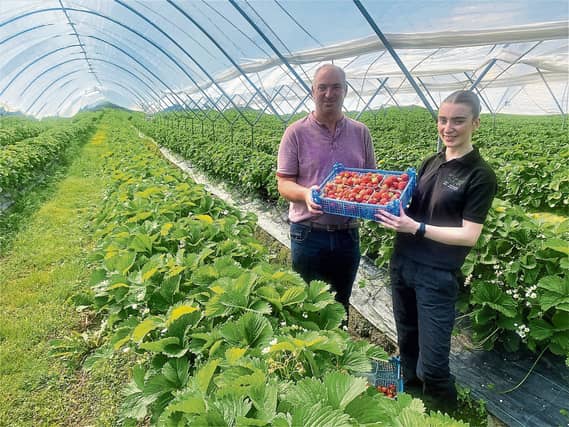
Niall and his family preside over the cultivation and harvesting of soft fruit; strawberries and raspberries mostly, but also some ornamental plants. They also operate an “honesty shop” selling farm produce.
It's a busy time for Niall and his family as the crops are ripening. On top of the day-to-day operation the Colehill farmer has additional responsibilities because of his IFA role. He recently headed up a delegation from the association that met with Senator Regina Doherty to discuss pressing issues for the sector.
How does a Midlands farmer get thrust into a representative role for a sector dominated by East Coast players: “The farm was small enough when we started out, we needed something intensive,” Niall says of the initial venture into soft fruit, “We originally grew mushrooms. The mushrooms were exported to the UK.
“That got problematic with fluctuations in Sterling, price differential and labour problems. My brother was growing strawberries. I took over that side of the business and I built it up from there.”
Strawberries were grown on the farm since around 1995, but the move to intensification happened in 2003: “We saw there was a market for it. The strawberries could be grown in tunnels, so we didn't have to be in the sunny South East. The tunnels protect the crop from rain and keep them warm.”
Producing a crop is only one part of the business. The more important part is selling it: “There's a fair bit to selling it. You have to “go out” and sell it. A beef farmer puts his cattle on a lorry and they go off to a factory. We had to physically go out and sell the crop. Talk to shops, that's hard graft.”
From humble beginnings McCormacks now produces up to 60 tonnes of strawberries a year. Finding markets for the produce is as difficult as keeping the crops alive: “It's a balancing act to be honest. You have to be a Jack of all trades.”
A UK consultancy company reviews the crops, the plants themselves are bought from the continent and crop management is “high tech”. Niall speaks of industry changes in the last 20 years: “It's gone from a few strawberry plants to a very high tech and intensive industry. The number of growers have gotten smaller and they're more specialised.”
“The plants are grown on farms in Holland, Lithuania, and France. Our strawberry plants for next year are being developed as we speak. We get delivery of them, plant them and pick them.”
The plants will provide two crops over 13 months, delivering sweeter bigger strawberries.
Like all farmers the strawberry business has felt the pinch caused by dramatically escalating costs: “That's causing huge headaches. Fertilizer has come down about two or three euros, but that's from costs of around €60. We're caught in a bad situation at the moment, as is the whole horticulture industry.”
Through his IFA role he is conscious of what this means: “We are worried about the future of the horticulture industry in Ireland. There's less acreage of vegetables grown. There's a projected 7% reduction in the acreage of veg growing this year because people have got out, because prices have not kept up with the price of inflation. Older growers are scratching their heads and saying “this isn't worth it, we're getting out”.”
Niall enjoys the responsibility of being a farmers representative: “I've had years of experience with mushrooms. I suppose that benefited me when I got the IFA Committee chair. I am representing growers and trying to fight for their situation.
“We met with Senator Regina Doherty. We discussed issues like labour shortages, work permit issues and various other issues. There's a continuous campaign to try and improve the lot of growers,” he says.
That meeting flagged a range of issues: “Growers are under a lot of pressure. Supermarkets offering 49c carrots or other veg is not sustainable. We are using up the earth's resources in a manner that is detrimental to our own future. It will mean that we are going toward a place where less growers will be growing produce. It will affect the food security of our nation.”
“For sustainability, for working into the future, there has to be a greater awareness by the general public that we are at a crossroads. A lot of it is education. There has to be a change of mindset.”
The business is very much a family enterprise. Niall's daughter's Leona and Katie are busy on the farm.
Leona outlines her day: “I start at 7:00am. We go into the pack house, if there are strawberries left over then we pack for the supermarkets as the women are picking. Once they are picked, the crop is brought in and we pack in the storehouse, put them in the fridge and then it's off on the delivery.
“There is a lot of minding. A lot of work that goes into on a day-to-day basis,” she tells.
One of the innovations is the honesty box: “That's my sister's (Katie) idea. I'm in college, so I'm only here during the summertime, but Katie set up the honesty box. She sells strawberries, raspberries, eggs, homemade jam, honey, and elderflower.
“She does that in the summer months from May till about September or October, and it flies out. The locals love it. It's really good for the community. She's done a great job on it,” Leona explained.
Niall says being conscious of sustainability is crucial for the future: “The whole fruit and veg industry in Ireland has become more sustainable. We use things like nematodes and beneficial insects instead of spraying herbicides and pesticides. We use windflowers to attract bees and natural pollinators. It makes total sense. You have to be on the edge of innovation, constantly looking at how to progress forward.”
McCormacks Fruit Farm will be delivering strawberries to a range of outlets right up to the end of September.