

The games people play: Longford video game expert talks up industry's merits


The very first commercial video game was Pong. It consisted of a dot crossing a screen. The player had to crash into it with a bat to return it to whence it came, a rudimentary tennis game.
That was back in 1972. Since then things have moved on a little.
The global video game market size was estimated at $217.06 billion in 2022. Yep, billion.
A new adventure game, Baldur's Gate 3, launched earlier this month and has already sold 5.2 million copies on Steam.
So the days of parents yelling at their kids to stop 'wasting their time' playing video games is probably as much a relic of the past as Pong.
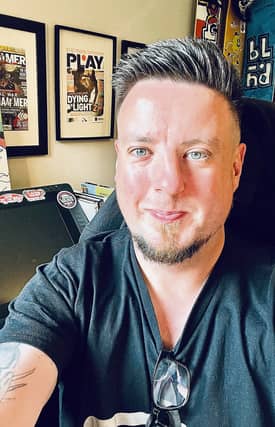
3D artist James Brady is originally from Clones, but now lives outside Drumlish. As a lead games design professional James has contributed to titles like Red Dead Redemption 2, Dying Light 2, Halo Infinite, GTA Online, PUBG, Ghostbusters and PokerStars VR.
It's been a helter skelter ride for James: “It's coming up on eight years this September.
“It flew by, very quick,” he told the Leader.
In that time the leap forward in both the software and hardware that accommodate the gaming industry have been remarkable. Gaming fuses cutting edge technology with entertainment, and the main players have become household names.
“I currently work remotely as a Lead Artist with a video game studio based in Edinburgh. They are called Build A Rocket Boy and are founded by Ex-Rockstar Games talent,” he outlined, “they have studios in Hungary, France and Edinburgh. I look after teams. A large part of that is working on the relationships with outsource vendors.”
To use the vernacular of a younger generation “relationships with outsource vendors” is not very cash money. Surely working on video games is all about excitement: “I oversee a lot of the props and many of the weapons,” James added a little more pizazz to his work description.
“In Dying Light 2 I worked on a lot of the lootable chests players would pick open and salvage items from. I also do things like props to be placed on walls, generators, chairs, dumpsters.”
James' work is about adding detail to the world where the game takes place: “I get reference material relevant to the game. Oftentimes we have concepts to follow. I gather information from which we create a model. That's handed on to the Environment Art team and they are responsible for placing it in the world. If they are happy with the size and dimensions we continue our work to bring it up to its final quality.”
His digital art plays an important part in the process: “It's about telling the story. We create our models in 3D, adding texture. It's to make everything feel as real as possible, so the world the game takes place in is as real and as lived in as possible.”
James has worked on games that absorbed untold millions of gamers' hours. His day job is about providing a digital escape for the user. He now looks at those games differently.
“I still play games when I get time to. Often when I am finished working my girlfriend will be playing games, and I watch, but to be honest when you have been looking at it all day it can be tough to enjoy.
“That said, I am definitely catching up on some games at the moment. I try to not look at them as a developer and just enjoy them for what they are. That's not the easiest thing to do. You could be walking down a hall in a game and see a flicker of something going wrong. You just walk back and forth in the same spot, watching the transition happen and think 'that's weird'. I try not to do that too often.”
James' route from Clones, Monaghan to Drumlish, Longford has been somewhat circuitous: “After college I moved to England to join a studio over there called Creative Assembly as a tester. I knew I wanted to make art for games. During that time I worked on my portfolio. I bounced ideas off the art team and got a lot of support. I did that for 12 months. I saw Rockstar Games were looking for an artist for Red Dead Redemption 2. In my mind I thought “there's no way I will get that”, but I applied anyway and ended up getting it, so I moved to Edinburgh.
“After that I wanted to move back to Ireland. I got an offer from Ubisoft to work in Toronto, but I just wanted to go home. I got a freelance contract. It blossomed from there to me working on a lot of iconic games from the home I grew up in. I worked on Halo Infinite. I grew up on the Halo games. Here I was working on a game in the same house where I received my first XBox for Christmas with Halo 1. It was pretty wild.”
The technological advances that changed how James works have also changed where he works. He uses a data connection satellite internet operated by American aerospace company SpaceX: “ My girlfriend is from Longford. As I work remotely it just made sense for me to move here. Because we live in the countryside I use Starlink, Elon Musk's internet connection. Studio's typically send you a computer from the office that has all of their software and security in place. You connect through a VPN to keep everything secure. There are Non Disclosure Agreements in place. You can't tell anyone what you are working on. There are also Non Compete Clauses, you can't work for competitors, often for a period after the project is finished. It's very hush hush.”
Gaming is one of the big three of the entertainment industry, along with film and music. There's cross pollination between the different branches. James has worked with musicians such as Deadmau5 and Robin Finck on digital projects.
“I got in touch with Deadmau5 when he was working on a project on Unreal Engine (a 3D computer graphics game engine developed by Epic Games). I did some content on that.” he tells, “Then Robin Finck, guitar player from Nine Inch Nails and Guns and Roses, started a studio. He contracted me to do some props for games he was working on. The video games industry is very tightly entwined with the music and film industry. You cross paths with a lot of people in both.”
CO:WORX Edgeworthstown is cited as an illustration of how future projects can be connected without being cheek by jowl: “I co-founded a studio remotely with a guy in Australia. We grew that studio, managing to secure contracts with Microsoft. It is down to experience and talent. The Irish government offers good support. It's possible to take on interns and get them to learn the software and over time they get experience and move through the ranks. If I can do this in Drumlish, you can do it anywhere in Longford.”
James has sage advice for anyone who wants to explore a career in the games industry: “Don't worry too much about your qualifications. When I review applications I never look at qualifications. Someone with a degree who has a bad portfolio is not getting hired. It's down to your own work ethic and passion. I'm looking for a portfolio that shows a lot of your own work and isn't just college assignments or online tutorials.
“Get involved with online communities. There is a website called ArtStation where you can post your work and get yourself known. Get a LinkedIn account, add contacts. Connect with art directors at studios, even as a student, that creates visibility and that's how you build a reputation. Over time you will become the guy people think of when they are looking for what you offer.”
If you would like to contact James his email is [email protected] and his website is https://bradyart.xyz/