

'Extraordinary' long-hidden mill wheel features and stonework uncovered in Longford

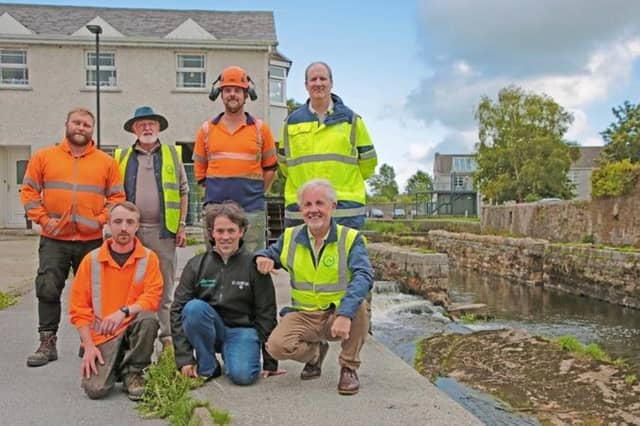

The Camlin Weir area on the river behind Great Water Street in Longford town had quietly disappeared from view over many years before these extraordinary features and hidden secrets were uncovered.
A fascinating, hidden treasure trove of historical artefacts, mill-wheel features and long-hidden stonework - previously at the heart of Longford's industrial life hundreds of years ago - has been uncovered and described as an 'immense gem'.
There are hopes to reveal further secrets over the coming months and this area, which lay neglected for many decades, now holds huge future development and tourism potential.
The Camlin Weir area on the river behind Great Water Street in Longford town had quietly disappeared from view over many years under a build-up of tree branches, fallen cut stone, silt and various items dumped in the river.
It was originally built almost 200 years ago to power two mills that were once at the heart of Longford's industrial life at a time when there were 50-to-60 businesses including a corn mill, a distillery, and later a sawmill and a hatchery.
At that time the Camlin Weir area was in fact the original business centre before trade gradually shifted to the southern end following the arrival of the canal and the railway.
This whole project traces back to a seminar in 2024 where Inland Fisheries Ireland and River Basin Management Services (formerly LAWPRO) explained that many weir structures across the country may be hindering fish passage in many rivers.
Longford Tidy Towns commissioned a specialist heritage and fish-passage study of the site in 2025 entitled 'The Camlin Weir -Heritage and Fish Pass Report', which was a multidisciplinary assessment of the Camlin Weir in Longford town.
The report includes integrating industrial heritage, structural engineering, archaeology, and aquatic ecology.
The study's two main aims are to conserve and further understand 'this important example of 18th Century-to-19th Century industrial waterworks, and to restore ecological connectivity by designing a new modern, nature-based fish pass that aligns with conservation and fisheries'.
Essential maintenance works are now under way to reveal it properly, assess its condition, and address a long-standing barrier to fish migration on the river.
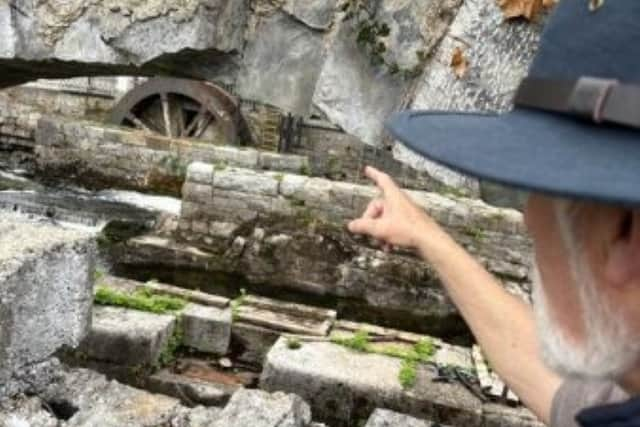
Longford Tidy Towns chair Michael Keenan said what is "particularly interesting" is that they have uncovered long-hidden stonework and mill-wheel features, providing a clearer picture of a stretch of river most people walk past without realising its history.
He stated there are some striking stories in the mix too - a Famine-era chapter, when one mill owner kept the mill running at half-price for local relief committees in 1847, before going bankrupt two years later.
Another hugely significant feature is a clever piece of 19th-century engineering known as the 'ancillary wall,' built to resolve a legal water-rights dispute between the two original mill owners over which side got adequate power.
Mr Keenan said the ancillary wall was described in a report by Shem Caulfield, an historian and consultant who carried out the original heritage and fish-passage study as being 'extraordinarily sophisticated and ingenious for its time'.
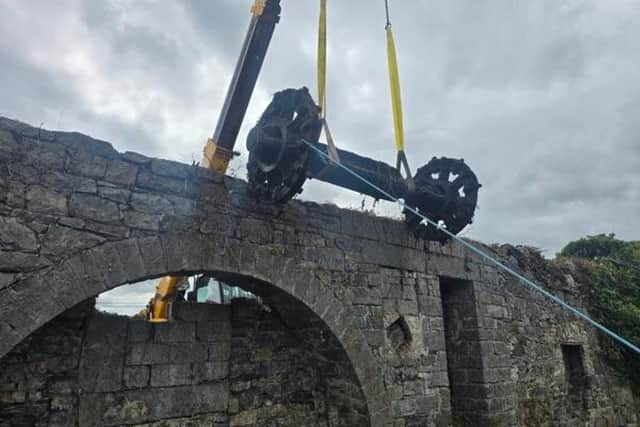
"Shem Caulfield was bowled over by it and he said that could really generate tourism and for people who are interested in this type of thing it's incredible," he added.
Anthony Daly, an arborist with particular expertise in weir structures, mill wheels, and heritage assessment, has played a significant part and he led the recent on-site works.
He stated Alan Sullivan, the director of a company called Rebus, who led the fish-passage study last summer, has created a very good report on the history of the Weir and what was going on.
Mr Daly said, "They gave the whole outline of it because there are big plans ahead.
"The big thing in Europe at the moment is fish barrier mitigation and removal."