

Garda recruits training in Longford
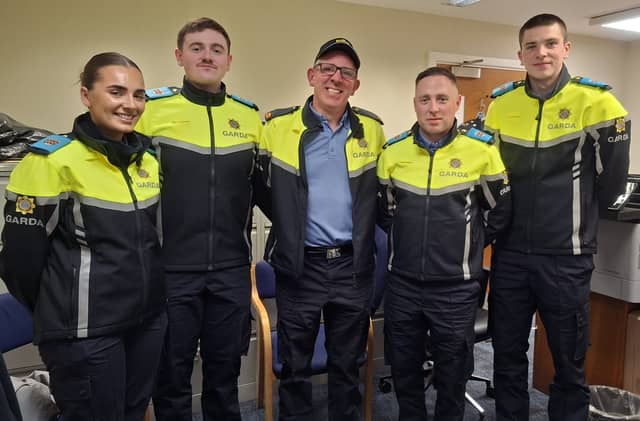

As a new Garda recruitment drive kicks off, the Longford Leader chats with four trainee Gardaí
Now in Stage Two of their training at the Garda College in Templemore, John Fogarty, Caitlyn O'Reilly, Daniel Rogers, and Connor Casey have settled well into their new roles.
Westmeath’s John Fogarty, set to be the first in his family to become a Garda, left his job as a production shift manager in Lakeland Dairies in Cavan - a role he had occupied for 7 years - in order to join the force.
Having always known he wanted to be a Garda, the reality of the job itself has more lived up to expectation.
“When I finally got in, I was so happy,” John begins. “Every day is so different; you get to meet new people, there’s different challenges, it’s a great role. It was a big change but a great one. I’m loving it at the moment. We’re on Stage Two now, so we’re getting to see what it's really like.”
Speaking of his parents, Jerry Fogarty and Joanne Gilchrist from Edgeworthstown, John smiles, “They're very excited for me, and very proud. They’re already talking about the attestation day!”
Cavan woman Caitlyn O’Reilly knew a career in the Gardaí was for her when she carried out her Transition Year work experience in Granard Garda Station at 15.
“When I left school I just thought I was still a bit too young to join, so I held off,” she explains, “Actually, two girls who had been on work experience with me both went on to become guards as well. Before Templemore, I was in college for a while but it wasn't for me. Then when the Garda recruitment happened in February 2025, I applied. Two intakes had gone in and I was still waiting, but I was determined to get in. I was delighted when I got the call!”
For Roosky man, Daniel Rogers - whose mum Anette is a GP in Longford, and dad Joe, an undertaker - joining the Gardaí was almost akin to a family tradition.
“I grew up around it,” he explains. “I have lots of family in the job, so I couldn't really escape it! My brother's a Garda as well. I’ll be number eight in the family to join. It took me a while to make the decision, but I finally made the jump, and I'm really happy I did.”
Cavan county footballer, Conor Casey, had effectively mapped out his career from the time he was primary school age.
“When I was very young and people asked what I wanted to be, I always said I'd be a guard,” Conor recalls. He meant it too. Connor was so intent on his path towards becoming ‘Garda Casey’ that he studied law and criminology for two years until the next recruitment drive was announced.
He explains, “I was always going to the guards, so I wanted to do something that was relevant to the job! The first day in Templemore was a bit daunting but since then I’ve really enjoyed it; loved it actually. The comradery between everyone is the best bit. We have a PBL group, which is problem-based learning. There are four people in each group and in my group there's a 49yr old woman, a 47yr old man, a 30yr old woman and then me, 22, and we all get on really well. The guy, John, was in the army before so I'd get advice from him and he'd give me guidance. I'd never had a bond like that with somebody in my everyday life. Somebody with so much experience that you can actually talk to about different things, it’s been great!”
Having gone through the application process themselves, the trainees share their advice as a helpful guide for anyone considering a career in the Gardaí.
“Be as honest as possible.” Caitlyn begins. “Make sure you disclose if there's anything that you or someone in your family has done in the past that involved the Gardaí. If you know it, say it.” She adds, “Also, the vetting is rigorous and that can take time. I remember they wanted to know about my uncle who passed away when he was 18. I had to provide his last known address, what he did before he died and things like that.”
Inspector McGlynn explains that if in the event of an applicant being unable to provide specific family details, or if, as can be the case, they don’t speak to certain family members and are therefore unable to get the information requested, they would have to go to a solicitor to get an affidavit.
For anyone worried about making the transition from the workforce to lectures, the recruits all offer reassurance that the adjustment is manageable and not as daunting as it may first appear.
“It was a while since I was in college,” explains John. “I was last in college when I was 21, and I'm 34 now so going back to college was a big change as well, but the good kind. Everyone is so helpful and there to support you so it’s not as difficult as you might think.”
Caitlyn adds, “It's enjoyable because you’re with people who are all interested in the same things as you. When I was in college in Dublin, I might have only had two classes during the day and you'd almost be forcing yourself to go in, but in Templemore, it’s nine to five; you're always at something. Everybody is also working together as a team because we all want everyone to do well. It's not all 18, 19 year olds or students in their 20’s either.”
“There's people in their 30’s and 40’s. There's a good mix of age groups. You just forget that everyone is a different age. Everyone just gets on so well with each other. Some students might have more life experience than others, but we all work well together. There wouldn’t be any cliques or anything like that.”
Speaking about the placement element of training, Daniel adds, "It’s a bit daunting to be on placement. It's like anything really, you don't know what you're getting into, but when you see it in motion, it's unreal. There's a buzz around it as well. You don't know what to expect each day, so that makes the job exciting.”
For anyone on the fence about joining, take the advice of those who have been through it.
Says Daniel, “For anyone that's thinking about putting their name forward, and if you're in a position to do it, just apply. It's a bit of a process to get in, but it flies by too. I think if it's on your mind, there's no harm in putting down your application.”
John concurs, “Definitely just go for it. If it’s in the back of your mind at all, just go for it and try your best. You definitely won’t regret it.”
Garda trainees receive an allowance of €354 per week for the 36 weeks of training. Accommodation and food is also provided by Templemore Garda College.
To apply to join the Gardaí, or to find out more about what’s involved, please visit garda.ie/en/careers/