

Jim O’Callaghan says he has no regrets over criminal legal aid dispute
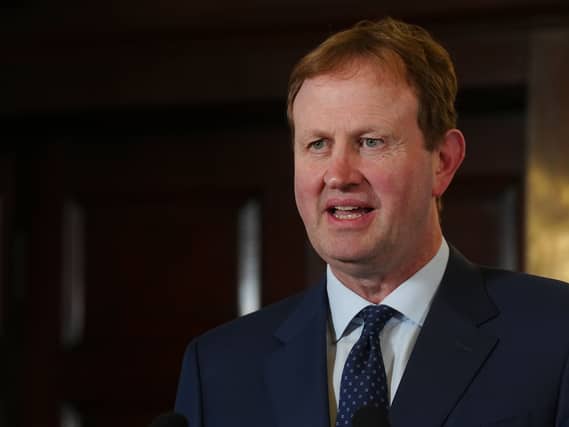

The Justice Minister stood by his stance as he revealed only a small percentage of cases will be entitled to enhanced payments.
Only a “small percentage” of criminal legal aid cases at the District Court will be entitled to enhanced payments, the Justice Minister has said.
Jim O’Callaghan told reporters on Monday that he had no regrets about how he handled a dispute with criminal legal aid solicitors which saw them withdraw services from the District Court.
The row emerged after the Justice Minister introduced a flat-fee model for criminal legal aid cases in the District Court earlier this year, with payments of 520 euro replacing a per-appearance scheme.
Solicitors withdrew services and the matter was also brought for a judicial review at the High Court, where a judge said the reforms were “grossly unfair” and that the justice minister had exceeded his power.
Mr O’Callaghan engaged with the Law Society over his proposals and later agreed a new enhanced payment scheme for “elongated cases” and separate and distinct cases brought on the same day.
The 520 euro flat fee still applies to single criminal legal aid cases but now solicitors can avail of 780 euro when two separate cases against the same accused are brought in the same day – and 1,040 when three or more cases are taken.
A 780 payment also applies for cases involving domestic violence, the children’s court, and cases with remands in custody.
It was reported prior to the announcement of the enhanced payments that the new scheme could see an increase in expenditure on criminal legal aid.
However, Mr O’Callaghan said he did not agree the reforms would result in more expenditure, telling reporters at the opening of the new Bailieboro Garda Station: “I believe it will result to less expenditure.”
He added: “Like if you look at the budget for this year in criminal legal aid, it was 122 million (euros).
“The problem was that last year was 41 million was spent on criminal legal aid in the District Court – 10 years ago in 2015, it was 19 million.
“Notwithstanding the fact that the number of cases have gone down, the cost was increasing very significantly.”
Mr O’Callaghan said he could not give a figure on projected costs under his reforms but said he was “fairly satisfied that you will see the cost of criminal legal aid in the District Court decline”.
Asked whether a concession he made that will see solicitors get enhanced payments in certain circumstances would mean that his reforms will cost more than initially projected, the Minister said: “The initial plan was that you would have 520 euro for every case.
“I have taken into account the fact that there may be separate and distinct issues, but the maximum amounts that will be paid – and it will only be a small number of cases – will be 1,040 euro.
“That’s the maximum that a solicitor can get for a criminal legal aid case in the District Court.
“And when you compare previously that people were earning multiple of thousands in respect of what was happening in the District Court from legal aid and then the cases been sent up to the Circuit Court, I’m very confident that you would see significant savings.”
Pressed on whether an assessment had been done about how much more his reforms would cost when he agreed to introduce the enhanced payments, Mr O’Callaghan said: “It depends on the number, the percentage now of cases which come before the District Court which will be entitled to the payment of 780 or 1,040 euro – That’s a small percentage.”
Asked if he had regrets over his handling of the dispute, he said: “No.”