

"The workload has trebled!" Longford paramedics explain why strike action was necessary


A planned 72 hour ambulance strike has been suspended
A planned strike by members of the National Ambulance Service (NAS) that was due to take place next week has been suspended following “constructive discussions” with the HSE at the Labour Court yesterday, Thursday May 21.
Prior to talks commencing, frontline ambulance staff staged industrial action across Ireland on Tuesday May 12.
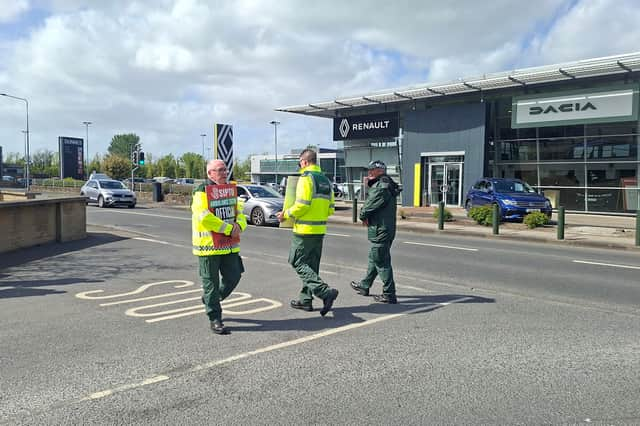
In Longford, the picket took place outside St Josephs’ Care Centre on the Dublin Road.
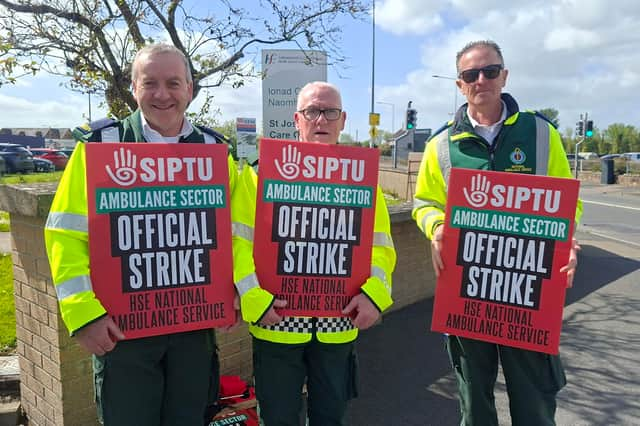
Speaking to the Longford Leader during the May 12 strike, advanced paramedics Gary Devlin and Brian McCaffrey explained the reasoning behind the protest, the reality of the job they do and why their trebled workload can sometimes mean Longford is left without an ambulance.
One of the issues at the core of the dispute is the HSE’s failure to deliver promised remuneration to paramedics who upskill and take on more responsibility.

Brian explains, “20 years ago, paramedics had 3-4 medications on board with them. These days they could have 20-30 medications, or 30-40 if they’re advanced paramedics. We’re upskilling, as it’s good for patient care but it’s not recognised in our pay. The remuneration hasn’t moved with the skill levels.”
Adds Gary, “We were told with all the upskilling and extra training we're doing that we would be remunerated. We never got it.”
Brian, who is 25 years in the service, points out that a significant amount of work also has to be carried out before the shift even begins, from restocking the ambulance to cleaning the vehicle and ensuring everything is as it should be.
This too remains unpaid.
Shockingly, their workload has grown to such an extent that Longford is sometimes left without an ambulance.
Explains Gary, “If, for example, we log on at 7pm and are called to a person with chest pains, we’ll carry out the assessments, but let’s say we have to bring them to St James Hospital in Dublin. If St James’ tells us afterwards they're going to keep the patient, we then leave to return to Longford but what people don’t realise is that as we’re leaving Dublin we could be called to the nearest incident. We could be called to Cellbridge, Naas, and so on.
“If the call out for the nearest resource comes through and if we’re the nearest (after leaving a Dublin hospital following submission of a patient), then we have to answer it. So on Monday and Tuesday night there might only one crew in Longford. There used to be two (crews) but the powers that be decided to make it one. If we’re in Dublin, there's none covering Longford.”
Adds Brian “People might think isn’t it great there's an ambulance service in the town, but sure as Gary says, after we log on at night we could end up in Westmeath, Offaly, Cavan, etc”
Last July, amid negotiations, the government presented a deal for a pay increase, which, as Taoiseach Micheál Martin recently told the Dáil, the ambulance workers rejected. What was not outlined however was the workers’ reason for rejecting the deal.
Brian explains, “The way we're paid there's a lot of add-ons and subsidies and different things built into our wages, which has been there for years, like shift allowance, cardiac allowance, overtime, etc. The HSE are saying they put a proposal in front of us last year where they were basically giving us a salary and cutting out all the subsidies.”
“It looked like they were giving us €8-10,000 a year on top of our salary which sounds good, but if you take into consideration everything they were taken off, we were really only getting a payrise of around €2000. When the figures worked out we were giving way more than we were receiving. They basically gave in one hand they took it back in the other.”
Gary, who has 21 years of service under his belt, points out that the call volume has also gone through the roof as a result of the rapid growth in population.
“The volume of work we do now compared to five years ago has trebled. Last Monday night I logged on at seven o'clock, three minutes past seven I got a call and I didn't get back to the Longford station until 9am the following morning. No tea break, nothing.”
"The problem is there's not enough crews on the road and the population has grown so much. Crew numbers have reduced because people are leaving the job. There’s trainees coming in but they only last a few years. People are frustrated. Something needs to change”