

PICTURES: Remembering the 18 Longford men who died in World War I
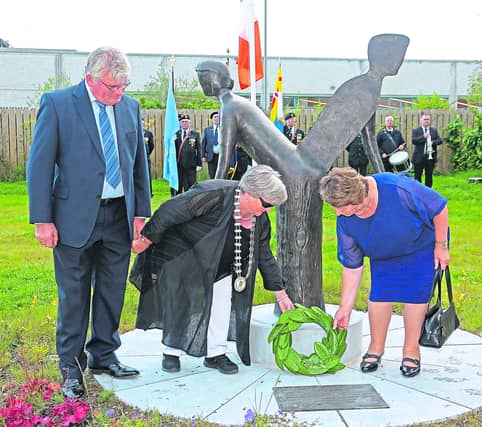

Ceremony to mark the 100th anniversary of the Third Battle of Ypres, ‘Passchendaele’
The ceremony to mark the 100th anniversary of the Third Battle of Ypres, ‘Passchendaele’ attracted a large gathering who in the beautiful sunshine remembered the young men who gave their lives in adverse weather conditions and harrowing circumstances 100 years ago in ‘The Great War’.
The Longford men who died included: John Arthur Adams; Francis Bennett; Patrick Boland; Bernard Carberry; Peter Collumb; Francis Robert Dignan; Patrick Bolan; John Dowler; Edward Dowling; George Anfield; David Glennon; George Harte; Hugh Loughrey; John Hopkins; John Maguire; Thomas McNally; George Stephenson; Joseph Ward.
During last Friday’s ceremony, a wreath was laid by the Cathaoirleach of Longford Municipal District, Cllr Mae Sexton and a member of one of the deceased Longford men’s family to the backdrop of the Green Fields of France which was played lamentably by well-known piper Noel Carberry.
Cathaoirleach, Cllr Martin Mulleady welcomed all those gathered, in particular the relatives of the local men who died.
He said it was important to remember the dead and to acknowledge the important role they played in shaping the world.
Local Historian Hugh Farrell then gave a talk at the library where the official opening of ‘Longford & the Great War: Passchendaele’ exhibition took place.
The Battle of Passchendaele, also known as the Third Battle of Ypres, was a campaign of World War 1, fought by the Allies against the German Empire.
The battle, which took place on the Western Front, from July to November 1917 was for control of the ridges south and east of the Belgian city of Ypres in West Flanders; Passchendaele lay on the last ridge east of Ypres.
Further operations and a British supporting attack along the Belgian coast from Nieuwpoort, combined with Operation Hush were to have reached Bruges and then the Dutch frontier.
The resistance of the 4th Army, unusually wet weather, the onset of winter and the diversion of British and French resources to Italy, following the Austro-German victory at the Battle of Caporetto - October 24 to November 19 - enabled the Germans to avoid a general withdrawal, which had seemed inevitable in early October.
The campaign ended in November, when the Canadian Corps captured Passchendaele.
In 1918, the Battle of the Lys and the Fifth Battle of Ypres were fought before the Allies occupied the Belgian coast and reached the Dutch frontier.
Photos by Shelley Corcoran