

My previous life in the attic

Considering tidying your attic during the Covid-19 lockdown? Well, here is some valuable advice
It is daunting and exhausting to clear out the possessions of somebody who had died. But to sort out your own accumulated stuff is a different matter altogether.
After fifteen years since arriving in Ireland, the Coronavirus lockdown presented the ideal opportunity to do exactly that in my attic.
I could spend as much time there as I deemed necessary. Surely one week would be plenty? I owed this task to my children and anyone else that would have to get rid of my things when my mortality kicked in.
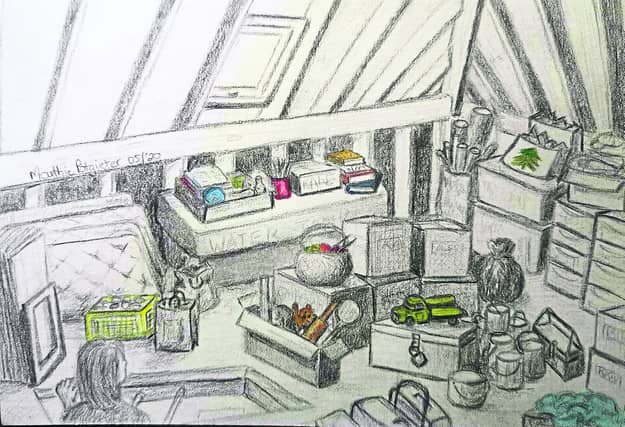
Initially all extras and ‘we’ll-sort-that-out-later’ stuff was stacked neatly around the edge of the attic floor. But time and haste resulted in a great mixed-up mess.
The most delightful expression describing it for me is, ‘balagan gadol’, a Hebrew expression I learned when I worked in Israel many years ago. It has a nice sound and feel to it. It sounds like a crow’s-nest, or the devastated scene after a hurricane.
There was only space to step over various sized boxes, crates, half empty tins of paint, canvasses, and toys, hidden away or brought from downstairs when guests were coming to visit.
After each of our parents died between 1992 and 2018 we had to go and sort out their worldly goods. Just before the lockdown a widower-friend also suddenly passed away and we had to assist in tidying up his things.
I experienced hands-on, each time, what hard work it was and how time-consuming, even though they were all very tidy. It would be so much worse when things were untidy. It would be undeserved punishment for my children if they were left with such a task.
But of course, on arrival back home every time, life simply continued as usual. All good intentions of decluttering “the place beyond the ceiling” just hovered like a pesky fly in the back of my mind.
Lockdown, however, was the Now or Never opportunity to tackle the enormous job. It’s a full-time job, especially if you, like me, want to revisit every memory before it’s fate is decided: bin, file, charity, fix, or new tidy spot in the attic.
Twice I turned back down the attic stairs due to pure desperation of where to start, but finally the emotions, mind and courage kicked into an alignment and after a day’s work there, I slept a satisfied sleep from pure exhaustion.
As the bigger items found their allocated spots in the attic or bin, and the floor became more spacious, so did my emotions become more intense.
First the camping gear, which I thought I could sell or simply dump, got kept for maybe-use-elsewhere. It found its old spot in the one corner. Not a very good start. Then the household stuff and excess sheets that had been collected from the parents’ houses, were stacked in clear containers and marked. Next came the grown-up children’s toys, kept for their kids one day.
This was my first pause of pondering on memories…
I returned a day later and continued with the children’s boxes - to be sorted when they returned for a holiday and/or to take away when they had their own homes one day. (I will never throw out someone else’s stuff unless permission has been given.
I have seen too many tears from my mother and other people where someone else simply chucked out their treasured valuables, which meant nothing to the tidy-upper.)
After these, the husband’s boxes. (He did spend a couple of hours with his stuff, but gave up after he threw out two boxes of study files.)
Lastly I started with my own boxes. And this is where my little world crumbled for a while.
I opened the memories of the life and career I left behind. It’s not that I don’t often think about what I used to do as an individual and also as part of a team, but here I had concrete memories in my hands. It’s in total contrast to what I’m doing now.
I opened files and found articles, notes, speeches I wrote for my superiors and other talks which I delivered myself. It felt good to recognise the high standard and good quality we maintained, especially in international events, which we organised and presented.
Other stuff I had forgotten about, was great to find: boxes full of hand-written letters, articles, photographs and diaries from school days, study years, volunteering in Israel and Lebanon, and after that, my first posts at different organisations.
Having now been transferred to the past in my mind, I was thinking of my career - first as a Social Worker in a hospital, and then, having made a mid-life career change to become the Public Relations Practitioner in the same hospital, I recalled the good and the bad, times that I struggled. I was proud of my work though, and loved the versatility of corporate communication.
I remembered the few situations that were not so great, where I experienced bullying from some of my superiors, and where there was misunderstanding and conflict due to things gone wrong, which were not in my control (e.g. a printer breaking just before a deadline). I now found myself in emotional turmoil, regretting some decisions that I had made.
I remember shortly after I started in the job as PRO, our hospital hosted a function for doctors from other hospitals. I arranged a venue and sent out invitations, but was told that I didn’t have to organise any refreshments, as one of the pharmaceutical companies would provide it. Late in the afternoon of the event, after having been reassured several times that it would be delivered in time, I discovered that the refreshments consisted of only one single platter with a few sandwiches. I had never attended one of these functions before, but realised this was a crisis.
Hurriedly I contacted the superintendent who called his wife, who was a PRO elsewhere. She was furious and blamed me for being lousy. She saved the day with her experience and quickly bought all kinds of snacks and wine and came and presented it beautifully. But she never spoke to me again, even though I had been left in the lurch, and it was too late to arrange for petty cash to buy refreshments. A lesson learned - at a cost though.
Another awful experience was during the last two months of getting ready to relocate to Ireland. I was on my own, as my husband had already left to start his new job. When the schools closed for the holidays, I sent my children to stay with my parents. In the meantime I had been given a new job, standing in as editor for the company’s magazine for my last few months. I also had to do the layout myself. I was left with no support. It was the Summer holidays and it was Christmas (southern hemisphere). It was the first time I did layout on such a scale. I now know I should never have accepted the challenge - which I thought would be an advantage in my new life in Ireland.
The amount of work, and a non-negotiable time limit, was too much for me, along with having to organise the sale of our car, sorting out all our stuff (up to the last pin), getting rid of things we couldn’t take along, getting a cage built for our dog, flying him down to my parents, finding a relocation company and making endless inventories, running around for my husband for administration he needed done and so forth.
I was at work for about 12 to 16 hours per day, having to arrange everything in between, then went home to sort out.
Sometimes I only slept for two hours - even less towards the end.
During this time I had a burglary after the dog was gone. Now I also had to attend to the insurance claim, which took more of my time and added to the stress.
The worst, however, was that our section’s camera got stolen from the cabinet in my office. I was so careful to always lock the cabinet and my office door when I went out, but this day I went to another office to drop something quickly, and left both unlocked.
How convenient for the thief to blame me, who was leaving the country! I felt my name, my integrity, had been shattered.
I had no way of finding out who stole it, nor could I prove that I didn’t steal it. It bothers me till this day that they probably still believe it was I.*
Some people would say don’t over-think things. Others would say leave the past behind. But when you dig out old stuff from a previous life, you cannot but ache when the memories come alive again.
Even letters from family and friends, which I kept, can wake all kinds of emotions of sadness and loss. (I have not yet had the courage to read my parents’ letters.) But there are also joyful bits when little notes from one’s children or congratulatory cards appear. Even leftover pieces of fabric that I made little clothes or costumes from… Oh, and the family heirloom of stamps, mostly unsorted, which might be worth a fortune for all I know, turned up!
These all unleashed so many emotions and thoughts, swirling in my mind, causing a few sleepless nights and even feelings of depression, of mourning.
It is at this emotional point that I would advise anyone else to take a break. Process those memories and feelings. Do something about it like contacting someone and talking things through, if necessary. Make peace with the past and go on.
If I may, I would like to advise anyone else who needs to tidy up a big mess, to prepare themselves with the following few points:
l Make the decision to tackle the job. Apply your willpower.
l Observe: Take a good look at the whole scene in front of you.
l Make a rough plan of how you want to organize it all, e.g. which corner you want to work from.
l Start with large objects, so it is out of the way.
l Have paper and pen to identify sections and make sure that everything is accessible. Put up shelves if need be, or buy large, clear containers.
l Brace yourself that it can be physically and emotionally tiring once you start digging up memories.
l When you find it difficult to make a decision about something, think what a family member or stranger would do with it; how would they value it?
l Do as much as you can, even if it’s only two to three hours per day. But don’t brood over it too much.
l Even if you have to take a break for a few days, do go back to the job.
l If you know you will certainly not use something, have the courage to get rid of it and make peace with that.
It is obvious that if you declutter regularly you won’t get into the mess which I had to tackle, but know that if you have to, it will take time and effort (definitely more than a week for me eventually).
Sorting out, decluttering, tidying up, whatever you call it, is easier for some than for others. However, it frees one’s mind, heart and physical space.
Easy? No, not if you take life seriously.
Since I’ve had a good look at my precious former life, my mind and my heart is refreshed with forgotten good memories.
I can now have perfect peace for the unknown amount of years that is left to live.
* After I wrote this essay, I decided to search for my last boss’s contact details and called her. (She’s not on social media.) She was very surprised, but happy to hear from me.
When I told her how I felt about the camera, she immediately assured me that she never even considered the thought that it was me; I had too much integrity, were her very lovely words. What peace, as well as a friendship regained.