

Longford journalist Peter Geoghegan shares the story of his remarkable career
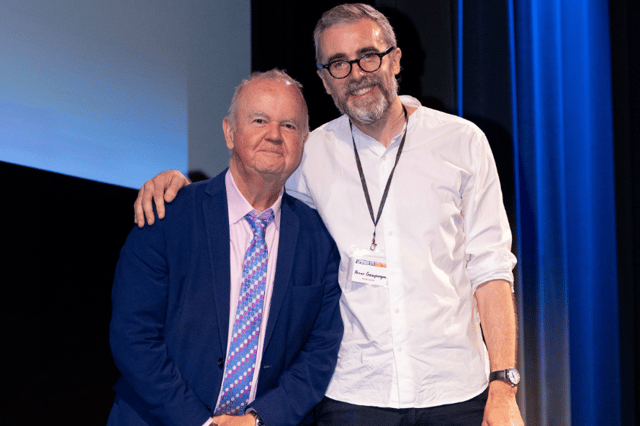

A former pupil of St. Michael’s Boy’s National school and St. Mel’s college, where he completed his leaving Cert in 1998, Peter Geoghegan said his fascination with writing started during his school days in Longford
Longford born journalist Peter Geoghegan has built a career investigating the hidden forces that shape politics, winning some of the industry’s most prestigious awards along the way.
The St. Mel’s college graduate recently won the prestigious Paul Foot award alongside his colleague Khadija Sharife for an investigation into how an organisation called ‘Labour Together’, the organisation that brought Keir Starmer to power, hired a PR firm to discredit journalists.
This adds to Peter’s long list of accolades, that includes a British Journalism Award and a best-selling book.
Now one of the most recognised investigative journalists in the UK, Peter’s interest in journalism began much closer to home.
“I always used to write things,” Peter explained. “I used to have a sheet that I’d photocopy and write fake interviews with fake politicians, write reviews of records by different bands and various other nonesense that was in my head.”
A former pupil of St. Michael’s Boy’s National school and St. Mel’s College, where he completed his leaving Cert in 1998, Peter said his fascination with writing started during his school days in Longford, however his route into the profession was far from conventional.
While finishing his PhD in Human Geography at the University of Edinburgh, he was working in the art college at the University of Ulster, Belfast, writing for an art website called Culture Northern Ireland.
That was when conversation over a pint with the editor of the art website changed his direction.
“I told him I had an interview coming up in London for an academic position and he said, ‘my lead journalist just resigned, I don’t suppose you fancy doing this job instead?’ and that’s how I became a journalist.”
Peter spent years working between Scotland and Northern Ireland before moving back to Scotland in 2010. He extensively covered Scotland's 2014 independence referendum for a range of publications, including Irish newspapers.
He then secured a place on Channel 4’s Dispatches investigative journalism training scheme, that trained and paid him to be an investigative journalist.
“Before that I used to write more feature-y stuff, culture and politics, but then I did the training scheme and moved into much more investigative work,” Peter said.
His investigations would go on to focus on political funding, lobbying and the influence of money in public life. He founded a Scottish investigative outlet ‘The Ferret’, that still exists today, and later became Editor-in-Chief of openDemocracy, where he led a series of high profile public interest investigations.
In 2020 he published his most recent book, ‘Democracy: Dark money and Dirty Politics’, a book examining the role of money and influence in politics. The book became a bestseller and was incredibly well received.
After leaving openDemocracy in 2023, Peter launched his own publication, Democracy for Sale, with two former colleagues from openDemocracy.
The publication focuses on investigations into political influence, corporate power and accountability, and has built an audience of over 56,000 newsletter subscribers.
“It’s great to have the ability to go to work every day with friends and do really high quality work that I enjoy”, he said. “I’ve never had more fun in my career.”
READ MORE: Congratulations: Talented Longford sportswoman leads Ireland to glory on international stage
The outlet’s work has attracted significant attention in recent months. The award-winning investigation into ‘Labour Together’ led to major political fallout, including the resignation of a minister.
Reflecting on the Paul Foot award, he described it as one of the biggest honours in the profession. “Someone said it’s like the Oscars of what we do, and I think that’s probably true.”
Looking ahead, he believes that investigative journalism remains as important as ever, particularly at a time when public trust in the media is under pressure.
“I do worry about the rise of AI on a personal level,” he said, “quite a few people turn to us as a source they can trust, which is great. People do want information they can trust.”
Peter mentioned recent research showing that trust in journalism is at record lows in the UK, and warns that AI presents new challenges for the industry.
“What we’re producing is a high quality product, and I think everyone that sees and reads it knows it’s not AI-generated. But it’s a wider thing. There are a lot of people who aren’t consuming quality media,” Peter said.
While he notes that the journalism industry has changed dramatically since he started out, he remains optimistic about the value of investigative reporting.
“When I first started out 20 years ago, the pay was very good. It’s very bad now,” he said. “There are far fewer jobs and far less job security. It’s a much more challenging environment.”
Peter still believes that audiences value quality reporting. “I think it’s very important to build trust with your audience. People see that you’re going out and trying to tell stories that are hard to tell, and they really respect it.”
For the Longford native who once filled photocopied pages with fake interviews, reaching huge audiences with influential stories is something he still appreciates.
“This morning I released my latest newsletter over a cup of coffee and next thing you know, 30,000 people had read it. Which is great. I love that.”